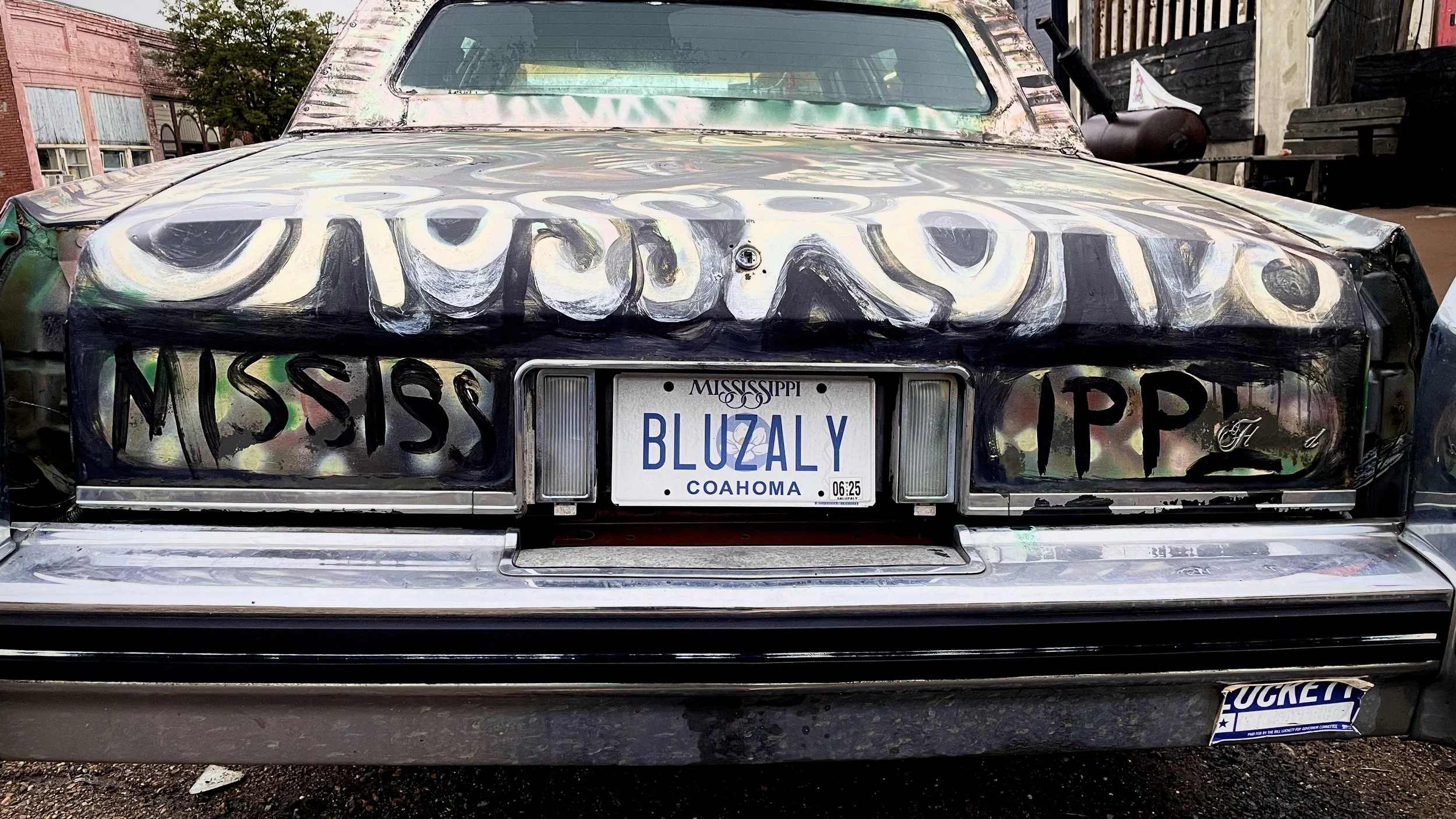
Mississippi: dotting the i’s.
Mississippi. The name alone carries as much history as the river carries sediment.
History here is heavy. Music too. Cotton, blues, prisons, civil rights, names that echo far beyond the state lines. It’s the kind of place where every road seems to lead somewhere important
We reach Tupelo at the end of the day.
The town surprises me first. Not the sleepy place I imagined but a wide industrial sprawl of warehouses and highways. Elvis’ birthplace can wait until morning.
The motel sits next to a truck stop. When I wake up the next day the world has disappeared into fog. The type of thick fog that swallows distance and sound.
I grab the camera and step onto the parking lot.
Through the mist appear the silhouettes of trucks. Huge shapes idling, headlights glowing like distant lanterns. One of them stands apart: a long black rig spitting dark smoke into the pale air, engine running, door open.
I walk toward the driver and ask if I can photograph the truck. Our accents collide somewhere between Mississippi and Europe. He thinks I want a portrait of him. I explain that I only want the rig. He insists again.
I misunderstand his insistence as refusal. I walk away and three days later I am still thinking about that image.
Damn.
Long road ahead; no time for breakfast. Fortunately the southern roads are dotted with a yellow marker called Dollar General.
Groceries, cheap clothes, tools and every kind of random household item. But more than anything, it seems to function as a social hub. People run into each other here. Conversations start in the aisles and invariably end at the cashier.
Coffee in hand, we get back on the road.
Somewhere along a rural stretch we stop for another truck. Shiny blue paint this time. Chrome here, mud there. The kind of machine that looks both proud and tired at the same time.
A man stands outside a small roadside shack used as a garage workshop. Meet Josh.
Sixty-nine years old and still “working on every diesel engine ever made,” as he puts it. White beard. Black hands. Grease embedded so deeply in the skin it will probably never leave. A cigarette fixed permanently in the corner of his mouth.
The truck isn’t his. The owner drives nights and is probably sleeping somewhere nearby. I work around the semi for a few minutes. Chrome, mud, tires, steps.
Josh talks about engines the way some people talk about family history. One model leading to another, a memory triggered by a part, then another truck, another decade.
At some point he pauses long enough for me to turn the camera toward him. Two frames that I will later realize are not the portraits I had hoped for. But the encounter was. The authenticity I missed in other places.
By the time we leave he is already bent back over the engine.
Clarksdale.
Announces itself long before you reach the town.
Blues signs appear along the road. Murals. Arrows pointing toward juke joints and clubs. The place proudly calls itself the capital of the Delta blues.
When we arrive it feels quieter than the legend suggests. Low season, I guess. The town seems suspended somewhere between half-purposed decay and careful preservation. Old brick buildings, faded paint, blues venues occupying spaces that once held something else.
Clubs still play music almost around the clock.
We walk into one early enough for a solid breakfast. Stage lights are still on although daylight already fills the windows.
Tony’s on stage, alone with a guitar and a harmonica. Country slides easily into blues and back again.
The room holds only a handful of people. Coffee moves slowly between tables while smoking hot plates arrive from the kitchen. That’s where I meet the people running the place.
Al owns the club. Marc works the floor. Joe cooks in the back. All three somewhere in their seventies. Faces shaped by time, cigarette smoke and long nights of music.
Al tells me his club was among the first here. Fourth actually, he says with pride. I make a few portraits while Tony keeps playing.
Outside, Clarksdale continues its strange balance between memory and daily life.
Inside, the music goes on.
In the Delta, flat land stretches in every direction.
Grain silos, water towers and timber yards rise above the trees. The horizon sits low, almost level with the car.
Cotton still grows in these fields.
We stop at a farm where a corrugated building stands beside the road. Inside sits a cotton gin, silent now, metal rollers and belts frozen in place like a mechanical relic.
The Delta is full of places that claim a beginning.
Some towns say the blues started here. Others say the same thing a few miles down the road. The signs are careful about it. Words like maybe and possibly appear often enough to avoid arguments.
We loop by Parchman.
There is nowhere to stop, only fences sliding past the car windows. Driving by, I hear Mose Allison somewhere in the back of my mind, wondering why he ended up on the chain gang, a twelve-gauge shotgun behind him —after all, he only shot his wife.
Later we pull over beside a field where tractors from several generations stand lined up like a mechanical family portrait.
While I look for an angle I hear the sound first. A distant rolling noise building slowly above us.
Geese. Thousands of them.
For nearly half an hour their formations cross the sky above the Delta while we stand beside the tractors watching them pass. When the last of them disappears, silence fades back in.
Every now and then a Confederate flag appears. Sometimes on a porch. Sometimes on the back of a pickup truck. Sometimes fixed to a pole at the edge of a field like any other marker in the landscape.
Part of me wonders whether photographing it would turn the image into something it is not meant to be. I am not here to make statements or collect symbols. Just to see what is there.
One of them hangs from a tree. Below, a white cross as an additional reminder of dark times. The flag itself carries a message printed across the fabric in case the message wasn’t clear enough: BACK OFF.
It hangs where every passing car can see it.
I stop.
Cars continue to pass behind me as I stand there with the camera. I hear them slowing down. Drivers trying to understand what that stranger is doing. I pretend to pee by the next tree.
When the road clears for a moment I take the picture. The cars keep moving.
For days I have been trying to photograph one of the timber trucks that roam this part of Mississippi.
They pass too quickly on the road.
Then one stands still. A white Kenworth parked outside an industrial yard, the trailer stacked high with freshly cut logs. I pull over immediately. The driver sits inside the cab filling out paperwork before entering the plant to unload.
His name is James. When I ask if I can photograph the truck he looks at me for a second, surprised, then breaks into a wide smile. Sure, go ahead.
The massive front grill first, square and heavy, chrome catching the late afternoon light. Then the long trailer behind it, the logs stacked like a wall of rough circles.
James eventually climbs down from the cab and watches with amusement. You drove all the way from Europe to photograph trucks? he asks. Something like that.
He invites me to climb inside. Three metal steps lead up to the cab. The steering wheel is enormous. The dashboard spreads out, filled with chromed gauges that would not look out of place in a spacecraft.
When the camera is finally put away he writes something on a scrap of paper and hands it to me. A restaurant in his hometown of Natchez.
Best steak around.
The restaurant looks exactly like the kind of place that takes its steaks very seriously. Dark wood. Heavy menus. Only a few tables occupied.
The steak on the menu looks magnificent. The price looks even more impressive.
I order a burger.
Our waitress arrives with the unmistakable accent of this part of the country, vowels stretching in directions I cannot quite follow. Mae understands most of it. I catch perhaps half. Fortunately she talks a lot. Long enough for us to piece together the broad meaning of the conversation.
Once the order is settled, she pulls a chair and sits down with us. Stories follow. Questions too. Laughter comes easily. Every now and then she remembers another table somewhere in the room and disappears briefly before returning to continue where she left off.
Time moves differently here.
The burger turns out to be exceptional.
Last day in Mississippi. I sit by the window of a small burger joint somewhere along the road.
A notebook lies open in front of me.
Behind the counter, the kitchen beeps steadily as orders come and go. People walk in from the gas station next door, place their order, leave again. The rhythm repeats itself every few minutes.
I write a few lines.
Just fragments for now. Names, places, small details that might matter later. Writing things down helps clear the mind even if I do not yet know what the story will be.
Outside the window, trucks pass on the highway.
Mississippi keeps flowing.
And I realize I’ve been thinking too much again.
I overthink. A lot.
This is me.
Note to self: Go with the flow.