Alabama: letting it in.
We cross into Alabama from Columbus (GA), looking for breakfast.
A diner sits just outside town. We park in front of it and before we even open the door, we’re already being seen.
Inside, the place is nearly full. Conversations slow and heads turn. Not hostile, not welcoming either. Just attentive.
We take the last free table while the waitress asks if we want coffee. “What can I get you, honey?” she says, already reaching for the pot. She does not rush; the bell rings behind her. On the counter, hash browns are cooling. Time stretches the way it does in places where no one is pretending to be elsewhere.
I want to take pictures, but don’t. For once, that restraint feels natural. Some places must be entered before being taken from.
Filled up, we head to Selma. It’s one of those names you circle on a map long before you hit the road. You know what it stands for. You know what you are supposed to feel when you get there. A bridge. A date. Images already printed in collective memory.
The bridge is there all right. When you step onto it, history presses forward easily. Names, marches, postures. Around it, people sell books, T-shirts, family stories. Lineages fold into livelihoods. I listen a lot, talk some. I buy nothing. I don’t belong to that memory; I’m not emotionally involved enough to take something home, other than the weight of the place.
Looking for a vantage point to picture the bridge, I turn around. There’s another bridge in town. No story attached. Just steel crossing the river. Makes for a good image too.
Selma feels heavy. The town is quiet, hollowed out, stretched thin. Restoration sits next to abandonment. Intention without momentum. I don’t stay long. I leave uneasy, which feels appropriate.
We stay on the backroads, as always. The road bends through Marion and Greensboro and smaller places with names that wouldn’t mean anything to anyone else. Backroads do something to time. They slow you into visibility. People ask where you’re from. Conversations begin without purpose. Curiosity travels both ways.
In Marion, the contrast with Selma is immediate. The town is small but intact. Colorful. Maintained. The kind of place where time does not move forward so much as it pools. We park the car. It doesn’t go unnoticed. Neither do the cameras. Curtains move. Across the street, inside the antiques shop, a lady sits on a couch, phone to her ear. She watches me while she talks. I notice because I’m used to noticing.
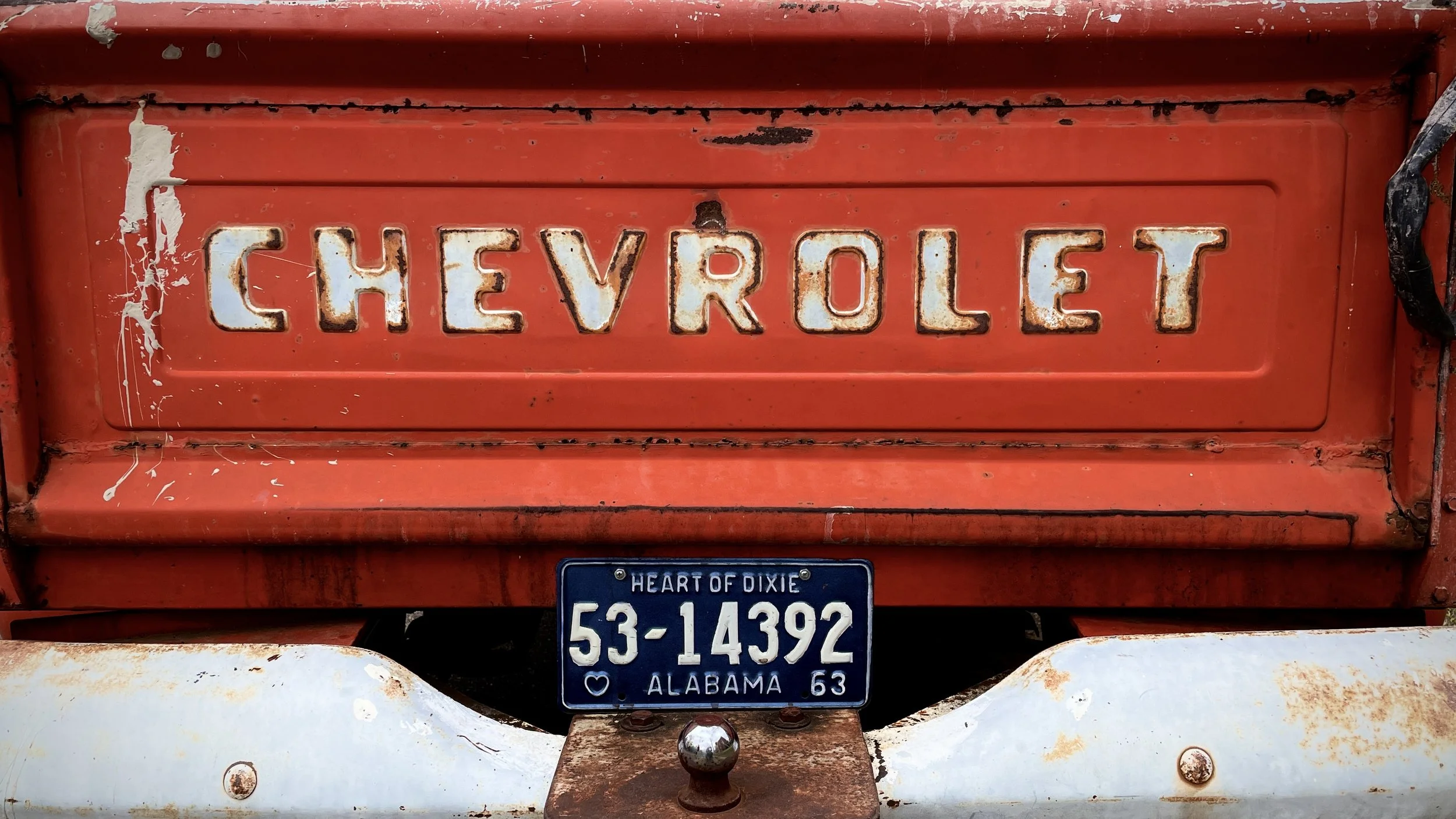
I spot a pick-up truck before I register the church behind it. An old faded-red Chevy. Rusted frame, mismatched hood, chrome catching the light harder than expected. I start photographing. The truck has that rare quality of having survived without being restored. I’m mostly attracted by the interior. Dashboard, windshield. Nothing special about it. What draws me in is the idea of conversations held between those seats. Of silence too. So many stories covered in miles. Makes me nostalgic about a time I haven’t known.
A man steps outside the building behind me. He introduces himself as John. The truck is his. So is the church.
He invites us in.
Inside, the light is low and directional, fractured by the stained glass. The building is old, early nineteenth century, born with the town. We talk. He speaks calmly, radiating a natural and benevolent authority behind his smile. He recognizes the cameras and likes the film approach: “We are analog beings in a digital world”. It could have sounded rehearsed. It doesn’t.
We talk about patience. About time. There is no agenda in the exchange. No attempt to impress. Just conversation. When he laughs, it’s open and unguarded. I try for a portrait but the light is low and I’m not sure it will hold. The best image might be the one of him in his truck, through the windshield, laughing at something I’ve already forgotten.
We come out and stand on the sidewalk longer than planned. He invites us to lunch but we have to decline; the road ahead is still long. As we walk away, the V8 starts behind us. The roar is deep, cavernous, unapologetic. There are sounds I wish I could photograph. This is one of them.
We warm up with coffee across the street. Sitting by the window, we talk about this precious moment we just had. Someone comes in to approach us directly. She saw me taking pictures earlier and wondered who I was and what I was doing. There is no suspicion in her voice. Just curiosity. Before leaving, she tells us we should “meet the ladies at the antiques”.
We cross the street into the shop. The lady by the window, now surrounded by friends, welcomes us: Where are you from? Where are you going? Why Alabama? We talk about this project and previous ones. About the town. When we leave, we carry more than coffee. Memories and a book by a local photographer. Images of small towns, patient and unforced.
They remind me of something uncomfortable and necessary: I want my own images. Not borrowed visions. Not expectations brought in advance.
Marion becomes a reference point. A proof of concept. Let go and things arrive.
Outside town, Alabama stretches into forest and clearings. Or cleared forests. Timber defines the landscape once dotted by white patches of cotton.
Trucks loaded with logs. Newly planted pines in disciplined rows. Smoke from burning slash piles. And animals. Too many animals. Flattened on the roadside; the cost of displacement accumulates: deer, foxes, raccoons, even birds of prey. The list extends. Hurts the wildlife lover.
And then, one morning, a family of deer crosses in front of us. They’re light, aerial. The last one pauses at the edge of the asphalt and looks back in our direction before stepping across. I don’t reach for the camera. Some moments don’t belong to film.
Later that day, it’s three road workers that stand in the middle of the road during a short pause. We share the break before I photograph them. They look straight at the lens, neutral, unposed. Men of the road in the most literal sense.
They ask what I’m doing. I say I’m traveling, photographing. Belgium…Europe. Spain? maybe. We settle somewhere between. Their job continues regardless of who passes through.
On that same stretch, I see a road sign listing the four cardinal directions with their numbered routes. And then a fifth arrow: END. It makes me smile. Four ways to go and one that feels both ominous and mildly absurd.
We catch the last light of the day in Greensboro. Wandering without purpose until hunger intervenes. A restaurant reopens the kitchen just for us though it is already closing. No hesitation. The sandwich tastes better than it should. Kindness matters more than ingredients.
On these roads, people stop whenever we pull over for an image. They ask if we need help. If everything is alright. Again and again. Care circulates by default.
Once, that rhythm breaks. A truck passes by with a Confederate flag in lieu of a license plate. I finish shooting and return to the car. In the meantime, the truck has already turned around. Comes back toward us. We leave before any interaction happens. Nothing occurs. And yet my mind fills the gap with stories, movies, myths. I catch myself wanting narrative. Prejudice works both ways. People are rarely as simple as the symbols they carry.
We choose the longest routes whenever possible. The most indirect. That choice takes us south, deeper. Names on signs pull us off course. Hurricane —the town— diverts us. Some places demand a visit even when they don’t fit the plan.
Mobile too does that. The kid in me wakes up again when in a military museum I get close to the airplanes that once made him dream of heroes and aerospace. Nearby, a retired sailor stands by a ship he once served on. His navy clothes are old but immaculate. He talks about routine more than war, about years aboard, about a life that still orbits this steel.
I ask for a portrait. I always take two shots. The first belongs to the idea of being photographed. The second, to the person who forgets the moment. When he salutes in the second shot, it’s not an act. It’s reflex, offered naturally, almost unconsciously.
Before this trip, Alabama was a blank space for me. No inherited images. No expectations worth trusting. That absence turns out to be a gift.
Note to self: You won’t outrun an eighteen-wheeler when crossing a backroad.