Georgia: the absence theory.
We’re getting close to New Year’s Eve.
I’ve started a different countdown though.
In a few days, I’ll take off on the second leg of my journey across the US of A.
Packing my bags, half in reflection, half in motion. The Southeast in winter; a different view probably. But I’m trying not to expect. Not to look things up either.
Filtering all the recommendations I receive, I want to keep a fresh and personal eye. It’s not because everything is available that everything of value is captured, let alone understood. I don’t want to miss what matters to me for the sake of someone else’s checklist.
Very early on in the development of this project, one concern kept coming back: how to choose what to see and what to leave aside. So far in my travels, I always knew where I was going; what I wanted to shoot.
And now, nothing.
Learning to let things come requires learning to let go. Coming from a life where preparation must meet opportunity to produce that proverbial luck, learning not to prepare is a challenge I didn’t anticipate.
Tank full, mind empty. Off we go. Ahead to Georgia by ways of Saint Agustine, FL. Old stones in the New World.
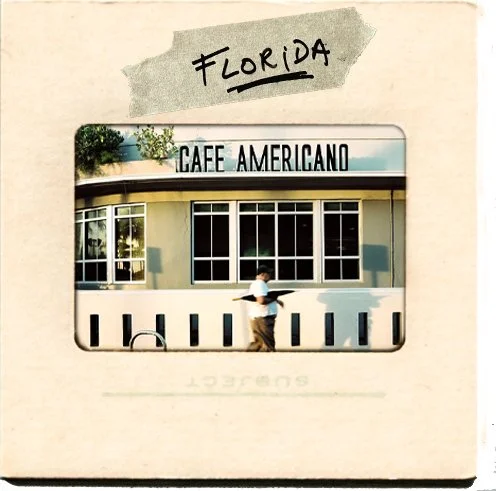
First stop for a quick roadside lunch. Some fries, ketchup, a coke. Typical diner scene. Colors that pop; checkerboard linoleum, the two regulars at the counter. Striped awnings and the ice machine outside.
The cameras intrigue an old man who asks what I'm doing. I take pictures. The idiotic joke gets the conversation started.
We talk about the project, film photography and the states I’m about to visit. He shares his story, but once he got started, I realize this might take more time than expected. Not that he’s slow. The opposite. The man was fast. Very fast. Spent his life working on dragsters.
And boy, does he drag. His stories are endless and fun to listen to but at some point, the road is calling. I mean to take his portrait but can't find the way to translate his character into an image. Instead, I turn around and capture the silence at the counter.
Soon after the state line, we’re stopped for a while. Not by traffic. By a freight train. We reckon about two miles long. No way around it. No alternative road. Just waiting. Cars idle. People step out. The guy next to us checks his phone, then gives up. Wagons slide by; the same shape repeating until it stops meaning anything. I take a few shots. I have time to find an angle.
Once the road opens again, it stretches. Empty in a way that isn’t dramatic. Winter fields. Lengths of pine forests. Low traffic. Long intervals without towns. An abandoned gas station appears, pumps rusted down to their bones, chrome dulled, paint flaking. I photograph them. A still life left behind without explanation. No trespassing. I do; hoping the image is worth the shot.
On the way to Savannah, an overgrown truck sits by the road, half claimed back by the forest. I stop. I shoot. It feels incidental, almost accidental, which suits me fine.
Georgia, so far, is duration.
In the next truck stop, I see a big guy in overalls with the big white beard and the mandatory trucker's hat. I'm crying internally for a picture but it's neither the place nor the moment for that. Truth be told, not the kind of guy you approach for a portrait either. I turn away from a very authentic image, hoping I'll have other opportunities somewhere down the road.
Savannah is the first real stop.
It should work. I know that; even as I try not to think it. History, texture, a city dense with images that have already proven themselves. I walk early —still night, really— before the city starts to perform. I slow down. I wait.
But I haven’t photographed seriously in months and I feel it immediately. The hesitation. The sense that the frame isn’t holding. I question the light, then the timing, then the framing itself. I tell myself it must be that. Rust. An eye out of practice. It’s easier to assume the fault is mine.
Savannah doesn’t owe me the image I made of it. It doesn’t owe me anything, really. Still, I try to reconcile what’s in front of me with what I thought I would find. I recognize places without recognizing moments. Everything is present. Atmosphere, history, volumes, light.
Yet, nothing quite settles.
The few images I checked online appear to be overly embellished. What was I thinking? That's literally one of the reasons why I quit digital photography and yet, I fall in the trap. Never mind, it's a good reminder that my work makes sense to me. I'm glad about this disappointment.
Two days later, I leave Savannah with ideas of photographs rather than photographs. And with the beginning of a thought that will eventually find its form at the end of the trip: I'm not sure I should do cities. I might have been too long in the wilderness. I might not be inspired by cities to start with. I might not belong there.
Perhaps some later state will contradict me. I accept to let the thought go and know I'll come back to it later. Unlike Savannah.
I wave goodbye to Florence Martus and move on toward Columbus, with more questions than I'd like to deal with.
Driving across Georgia, we get the same impression of emptiness as when we entered it. The road does most of the talking.
Rain starts falling. The tar turns dark, almost black, absorbing light instead of reflecting it. The surface becomes smooth, continuous, hypnotic. The lines fade. Everything narrows to movement and sound. Mae asks me how I would describe it in words.
Well, here you are.
In Columbus, we meet Ed; Mae’s tattoo artist.
I had imagined something else. A longer moment. Time to watch him work. Gestures repeating. The rhythm of the craft. A chance to photograph hands, concentration, the slow accumulation of marks that are there to stay. Of course it resonates with the photographer. But we only stay fifteen minutes.
We talk instead. About how the tools have evolved. Smaller. Easier to handle. Easier to learn. Cheaper. How the technique has changed without changing the nature of the work. Sweat and patience are still required. Many miss that and some are drawn to the craft because of it.
Ed smiles and says: these tools are what digital is to your film camera. The analogy lands.
I don’t take the images I wanted. I don’t take any image. Not because of etiquette. Because time matters. Time is my medium as much as light. And I don’t want to force it. I don’t even mention the idea. That would make it posed; the opposite of what this project is about.
Through Ed, I meet Coralee. She offers us her house without hesitation. No ceremony. No expectation in return. Just a gesture, direct and unguarded. Southern hospitality. Again, I hope for a moment. A portrait of them both. It doesn’t come; I let it pass.
In the evening, I have time to think (more). I settle in the house generously put to our disposition by Cora, where I happily discover a bunch of vinyl and a working turntable. Elvis and Johnny Cash fill the air of a winter evening. Hot tea on the table watched over by Burt Reynolds and Kitty Wells on the walls.
I sit with what just happened. Or didn’t. With expectations I thought I had dropped, yet clearly hadn’t. With the idea that refusing to expect doesn’t mean expectation disappears. It just becomes harder to spot. You can’t think your way into images.
From one end of the state to the other, Georgia feels less like a place I entered than one I crossed. Distance more than destination.
On the last day, closing the loop back toward Florida, we detour by Georgia. Another stop. Another try. A windmill this time. Overgrown like the truck the first day. Empty. I give Georgia another chance, knowing full well it will remain Georgia. I give myself another chance, knowing full well I will remain myself.
The theory holds, at least for now: let come rather than expect. Trust that the frame will carry presence without being filled on command.
I move on with Georgia on my mind. Not as a place that withheld, but as one that set the tone early enough for the rest of the road to matter.
Note to self: Never regret untaken photographs.