Arkansas: what’s there to see?
The question comes from the immigration officer at the Atlanta airport.
- Me: “Good morning.”
- Officer: “Where to?”
- Me: “Arkansas.”
- Officer: “Business?”
- Me: “Vacation.”
- Officer: “In Arkansas? What’s there to see?”
Hard to explain that I have no idea since the very point of my trips is to discover. No self-respecting airport official would take that for an answer.
So, I go with “soccer”.
If you know me, you know I’m the one Belgian who doesn’t care for soccer. But even I know that a World Cup is on in the US. Or is it yet? Never mind, Americans caring enough about soccer to know whether it started yet are a rare species. I bet on that and win.
Off I go with a virtual stamp in my passport.
Landing in Little Rock shows me right away what a great idea small airports are. Baggage on the carousel before you even get to it. Only one way to exit the place. No more than five rental car counters. And because you’re the one customer in weeks, you get upgraded and drive out in a fancy 4WD (which, as it turns out, will be useful).
Way to start. Which makes up for the stress in Brussels the day before, when the airport closed because of violent storms, forcing all incoming planes to reroute to neighboring countries, thus making my own departure feel suddenly very theoretical. Eventually, the airport reopened, the plane made it in and I made it out.
So, it’s with a smile and the smell of a brand-new car that I head to Memphis, Tennessee. My Kodak-filled package is awaiting at Pam’s instead of the Little Rock location I initially planned, thanks to the ham-handedness of some staff at B&H. Never mind, the detour offers the opportunity to meet Pam, my friend Michael’s sister, who kindly accepted to have an almost total stranger’s package delivered to her place.
Pam turns the delivery mishap into a sweet afternoon, filled with conversations, laughter, slow-cooked pork ribs (sorry Texan friends; I promise I caught up later with your version of BBQ), a state line crossing on foot and the inevitable swing past Graceland. I leave Pam with my thanks and the promise to send her one image every day during the trip. A small return for a generous favor.
I cross the river back into Arkansas at Helena-West Helena and enter right away into a Confederate cemetery. No surprise there, I meant to visit it. The area has been a key battlefield in the Civil War and the town was home to no less than seven Confederate generals.
As often in such places, you take time to reflect. On time, on history. And something comes to mind, although, come to think of it, it sounds obvious. My thoughts drift from the Civil War to our present days and how divided the country is —not just politically but also culturally.
History somewhat is a living thing that stays around, without any notion of time. Only, its shape shifts in our vision.
Do we ever close a chapter? Do we ever make peace with a past? I always admired America —and Americans— for their ability to move on. Progress is ahead and won’t wait. But with a closer look, it becomes clear that no one escapes their history. Time may erode the scars, but they’re still engraved in the walls of our memory, or our culture.
I don’t travel to check a list of local must-sees but I sometimes get started in a visitor center. The men and women who work there are often passionate about the location, naturally friendly and always incredibly knowledgeable. Even when my questions are more along the lines of “What do you do when you’re not working here?” rather than “Where can I see this?”.
Either they’re originally from around and I get directions to the very local life or they’re not and I get to see an unexpected view of the very local life. Either way, that’s exactly what I’m looking for.
Authenticity. Rural America. Real life.
In Helena, with the help of Dawna, the visitor center’s manager who has the ultimate skill of drawing a route on an inverted map, while describing in detail what’s there to see in Arkansas, I get the broad strokes of a route throughout the state.
Back home, when I plan such a trip, I basically draw a red line that connects points of interest and towns that bear a name strange enough for me to circle it on the map. Miami, Oklahoma. Y City, Arkansas. Not to mention Bald Knob, Arkansas, where I had to go just for a selfie next to the city sign.
But I didn’t expect to come across an important landmark in the history of the United States. A stone marker largely covered by mud in a headwater swamp, surrounded by cypress trees and wildlife, small or large. Things leaning into shadow.
A granite block marking the initial point of a major land survey that followed the Louisiana Purchase and helped divide a vast share of the United States.
West of the Mississippi, the territory had already changed hands, names and flags more than once before the United States bought the Louisiana Territory from Napoleon in 1803. On paper, it was almost too good to be true: fifteen million dollars for an interior so vast it came down to less than three cents an acre.
But paper does not draw a country and no one in Washington really understood the area yet. After the War of 1812, with settlers moving west and veterans promised land of their own, the government needed lines. So two federal surveyors were sent into this swamp to set the first point. From there, the map would start spreading.
I can only imagine what they had to go through —literally— in those days to define the lines that would make their way to the maps and shape a third of the current United States. I’ve only been here for half an hour and I’m being gorged upon by a swarm of mosquitoes and other insects I can’t even swat away. Close by, I hear some clapping noise in the water without being able to identify more than a dark shape. Alligators clapping jaws? On what? Never mind, even my curiosity has limits.
Back in the car, trying to escape the 1000% humidity, I drive up north and spot an aerial show going on.
A crop-duster is working a field. But from where I stand, it looks like choreography at low altitude: tight turns, the same line flown again and again, a little lift over the power lines like a heartbeat on a monitor. I think of a weaverbird building its nest: repetition, precision, danger made graceful. Same aerobatics. Same illusion of ease. I stay with it long enough for the pilot to empty his tank and then follow him to the landing strip.
He notices me, waggles his wings as a “hi” signal and banks east…where no road leads. Too bad.
Not an hour later, the exact same display pops in my rearview mirror. I don’t think I can call that “u-turning”. More like “handbrake turning”, if there was a handbrake, that is. But we’re not in the eighties anymore and the fancy car has more say in the move than I do. Still, one sharp tire squeal later, I’m on my way chasing a plane and smiling at the inverted scene of Cary Grant in North by Northwest.
Fortunately, this one doesn’t go too far and I catch up with it on the strip, refueling. By the time I get to the offices and ask the manager whether it’s ok to photograph, the pilot’s about to take off again. I get to him just in time to take a couple of images of his shiny blue helmet against the deep yellow aircraft. In a blast of dust and noise, he’s up in the air and I’m back in the car, both en route. One with a very precise map to follow by the line and the other with a vague line on a map he knows he won’t follow.
On the Trail of Tears —one of them—, I follow history and memory. I stop. I read. I stop again. I meet. Before this trip, I read a very comprehensive book about Indian history and, in some way, I can link what I hear to what I learned. While I’m obviously interested, it doesn’t make for images. If anything, it surprisingly makes me want to leave the cameras in the bag.
I don’t feel comfortable asking for portraits here. Too posed. Too close to turning someone into a symbol. As for the signs, displays and museums, that’s not what I’m after either. This isn’t a circus and I’m not “documenting”. Inspiration fades.
And then a friend calls. When I travel, I don’t pick up the phone. I barely answer messages and I never check emails. Be here, now. But it’s Michael calling, from California. That’s a call you take. As usual with a close friend, we spare ourselves the platitudes and he asks me: “Do you let things come to you, as you should?” That hits the right spot. A reminder of my own process, that I sometimes let slip away. Later on in the trip, I’ll have another call from him. Once again, just when I could use a chat.
It reminds me that I may be the lone wanderer; I’m never really alone. For the better.
I want to reach Mountain View with the hope that the town holds the promise of its name. I arrive far too late for an exploration but decide to go out early the next morning and catch the sunrise across a bluff I’ve been recommended to see. But if I like to deviate from a plan, sometimes nature helps in that too.
The morning after, the area is covered in fog so thick I almost have to park the car and close the last mile on foot. Lucky I didn’t do that. I dodge a longhorn bull by a few inches. I don’t want to know how the encounter would have gone on foot.
Well, at least it helps manage my fear of heights. No view, no scare. I reach the edge but cannot see anything other than a solitary yellow flower. Two feet ahead of me.
A few hours later, coming back to the spot, the fog has cleared and my fear is back where it belongs. The view was oversold though, but nice enough for a picture or two and to enjoy a moment on my own, away from tarmac, motels and diners.
That encourages me to go further exploring the Ozark Forest. Winding roads, the rhythm of pine trees, overlooks, rock ledges, hollows and trails. I’m thinking I should have foreseen a little more time here to hike in the forest. But so be it. I’m already extending the plan and I’m glad I get to see this, however partial to the overall scene. There’s only so much time in a day and, still jetlagged, I have to reach the motel for some rest if I want to make the most of this one-month trip.
Between the Ozarks and the Ouachita Mountains lies an area of rugged canyons, rock-painted caves and waterfalls. Some rock formations strikingly resemble a turtle’s shell. A fragile armor made of sandstone. As if to counterbalance the fragility, the gorge walls carved by centuries of erosion look as if they’re about to crumble on me. In narrow passageways, I enter one of the ancient shelters and though I can’t take a decent image of the pictographs, I smile at the connection: Pictograph is also the model name of my enlarger in the darkroom.
I never really considered how long my images would survive me. I doubt the people who left these marks did either. And even if they did, surely not long enough for a stranger to stand here centuries later, trying to read what time has spared.
The Ouachita Mountains keep the geology going. Famous for amateur quartz digging, I take a chance and come back with a piece of smoky quartz and even a fossil-looking little rock, which I’ll learn is not a fossil at all but green wavellite. “You should be happy; it’s not so easy to find.” Oh, I am happy all right.
The road west from there leads me to Mena. I completely forgot about Mena. Until I pass the town sign and it all comes back, scenes flashing in my memory. Barry Seal. Tom Cruise. American Made. The movie wasn’t shot here, but the story very much happened here. Nothing around mentions it —for what seems obvious reasons— and it probably was a lower-key operation than depicted in the movie, but still. The small mountain town with an airport that became a node in a very murky American story.
If things went south for Barry Seal, so do I. Toward Texarkana. Another border town. Not just any border town. A town geographically divided and yet held together by a community that couldn’t care less about lines and frontiers.
The town lies on both sides of the Texas-Arkansas state line. That oddity alone makes for a good stop. And I’m not disappointed but not for the reason I thought. The idea of wandering through a town that splits and joins made me think I’d find some particularities. Surely enough, the town must have a tourist board dedicated just to this.
And yes, of course, there are reminders everywhere that you stand on two states at once. The courthouse, also acting as the local post office, sits on the exact line. And not only do I find signs of it but there’s even a pole in front of it, built to hold smartphones for the mandatory selfie with the two-states sign in the background. The me-in-front-of-things culture, officially supported. Anyway, I take the picture of the building and turn around to scout the area.
Old buildings under renovation, with the hope of a historical marker and a few more tourists. Statues and manicured parks. I want to scratch the surface and push further, beyond the obvious. I reach a disused train station. Not ruined enough to be useless. A freight train comes in, and I take a chance shot because it goes too fast, but who knows, that could bring a nice surprise in the darkroom. Standing there a while after the train rumble becomes just a fading clatter, I notice farther down the tracks another yellow giant.
Earlier in this trip, I missed by a few seconds the dream picture of a freight train whose yellow locomotive, headlights on, was catching the sunset light, low in the frame. I know a missed shot happens. Oh boy, don’t I know it, but the image remains engraved in my mind, and I keep an eye open for the next opportunity…that never comes.
But this one is there. At a stop. No locomotive, no headlights, no sunbeam low enough to give it the spark any image needs, but I get to the tracks anyway and shoot the giant. Because gigantic it is. Inside, I gather it carries brand-new cars. Two levels of them. Once again, difficult to render the size of it but I enjoy the sight, with the memory of the image I actually want still hanging in the back of my mind.
Because I get lost (No GPS when scouting. No influence; pure discovery.), I find myself at the other end of town, by some railroad tracks again. Just as I’m crossing them, I see it. I can’t quite believe my eyes. It’s even better: Not yellow. Red. A deep clean red. Headlights on.
I questionably park the car on the side and race to find my angle. I have to guess for a minute because from this side of the tracks, I won’t see the train, which is right around the bend. I hear it. How could I not; the engineer starts blowing the horn. But I don’t see it coming. No, you can’t. No, you don’t. Don’t you dare stop now. Behind the curve. Out of reach.
I risk a step. Then I just go across the tracks. I see that there’s no risk. The train is coming all right. At a speed of about half a mile per hour. And once again, I can’t quite believe it. I “rush” back to my vantage point. Take all the time to adjust the camera; there’s no missing this one.
And it comes. The red steel monster. Majestic in slow motion. I’m about to go deaf as the engineer keeps blowing non-stop now that he sees a guy crouching low at the edge of the tracks. I get my shot. Or so I hope anyway. Sometimes, I just know I got the shot. Not this time. And somehow, that makes me want it more.
With that in the box —hopefully— I get going because the last usable light is gone and it’s time to find my motel with the usual end-of-day question: what is it going to be this time? Borderline insalubrious or somewhat okay?
The next couple of days are dedicated to Native history, old frontiers and military posts throughout some of the Indian Wars, as well as the Civil War. And once more, no image pops. It’s ok, some things are best reflected upon rather than printed.
I wind through the bends of the Ozark Mountains. And again, I can see why Arkansas is called the Natural State. Going with the Buffalo River’s flow, I see elk and deer so close that I could drive-by shoot them. But I let go. I just want to enjoy the moment driving through this green wonderland. Thinking about nothing. Rare enough.
In fact, I’m supposed to go down to the city of Ozark. But I remember a discussion with Pam and decide to instead go upwards to the corner of the state and check out the Thorncrown Chapel, designed by a Frank Lloyd Wright disciple.
I’m sure that, for those who are into it, the chapel must mean something, whether architecturally or spiritually. Me, I think I may have enjoyed the roads leading there even more.
Now trying to find a new route to get into Oklahoma, I circle around the town and just behind a bend, I spot the hitchhiker. 60-something, a schoolboy knapsack, a dirty Arkansas cap on and a large smile. At worst, I give him a few miles. At best, I get a good conversation out of it.
Enter Shawn.
Drifter by design, he left his house behind for his sister and took the road for better or worse. For the adventure. Lives on a monthly income of $800 and the support of whoever sees fit to help him in some way. He takes what comes: a ride, a meal, a laugh, a stretch of road, a stranger willing to listen. I recognize the method, if not the life. My project runs on a safer version of the same principle: don’t force the story, don’t overplan the image, just pay attention to what’s ahead of you.
We click right away. Is it the absurd humor and the love of sarcasm we share? Or the common interest in navigating the country without much of an idea of what’s ahead of us? Either way, we laugh a lot, share stories, discuss my project and his lack of one. All we know is we are both heading toward Oklahoma.
Because he used to be a trucker, Shawn knows the area pretty well. And that’s how the idea of going to Bentonville came up. The Walmart Museum in Sam Walton’s hometown. When we come into town, we quickly realize there’s a Walmart convention going on. Well, if I wanted to know anything about the enterprise, now is my time.
Much smaller than any one of the stores, the museum is no less interesting and filled with…what, 0.001% of the Walmart payroll? Still, quite a bunch of people that fills the entire space. So, we go out and by the time I change a roll in my camera, I lose Shawn. But as usual, changing a film in a 1960s camera is something few people see nowadays and inevitably triggers curiosity, if not a conversation. This time, it helps me in that the curious Walmart employee points me to Shawn, on the square across the street.
I find him playing a teenager’s guitar under a tree. The kid is there with a friend, both playing guitar. Not performing, just enjoying the moment. After Shawn’s jam —quite good actually—, we leave, but not before he tells the kids they should busk while they’re at it and even goes so far as to putting himself a cup on the ground and some change in it, “to incentivize the passerby”. I fall for it and add a few bucks before leaving.
We head toward the car without much of a plan in mind. “Hey, if you want the real thing, we have to go to Rogers”, says Shawn. No idea why, but Rogers it is.
The Walmart store in Rogers is not as large as most. And we don’t buy anything specific. A pair of socks will do. That’s all I need to have a receipt. The receipt that’ll bear the store #00001 on it. The very original store, opened by Sam in 1962. Quite the piece of Americana.
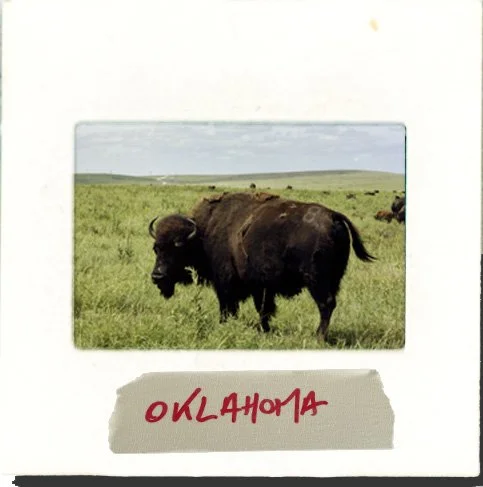
That little touristy afternoon took some hours off my schedule and it’s time to head on to my next destination: Oklahoma.
Shawn agrees vividly for some reason.
So that will be my Arkansas souvenir: a piece of history to think about, a piece of geology to take home, a piece of luck for the shots that came back around, a piece of Americana for the record, a piece of Hollywood for the romance and another detour that made more sense after it happened.
Note to self: Hiding in plain sight isn’t just an idiom.