Behind the scenes.
Coffee.
There is almost certainly a cup of coffee somewhere outside every photograph I make in America.
Usually nowhere near them. It may be in the car, going cold in the cup holder, or sitting on a counter somewhere behind me. Occasionally I have put it on the roof of the car because I have run out of hands and needed somewhere to leave it for ten seconds. Inevitably, one time, it ended up splattered across the motel parking lot. Sometimes it is still hot when I return to it, although that generally means nothing too interesting has happened in the meantime.
I never schedule coffee in a day. It simply is there.
It is there while nothing is happening. It is there when the day has gone wrong, when the night is impossible, when the motel was awful, when I have driven too far or not driven far enough, when the light is poor and I am sitting somewhere hoping things will improve in the next hour.
There is coffee bought at 6:08 in the morning because the place is open and nothing else is. There is coffee at 3:40 in the afternoon because the next stretch of road looks long. Then there is the dangerous late coffee, the one I know perfectly well will come back to haunt me around midnight.
I buy that one too. Because whatever.
Because I generally leave early for the good light, the first cup of the day is often motel coffee.
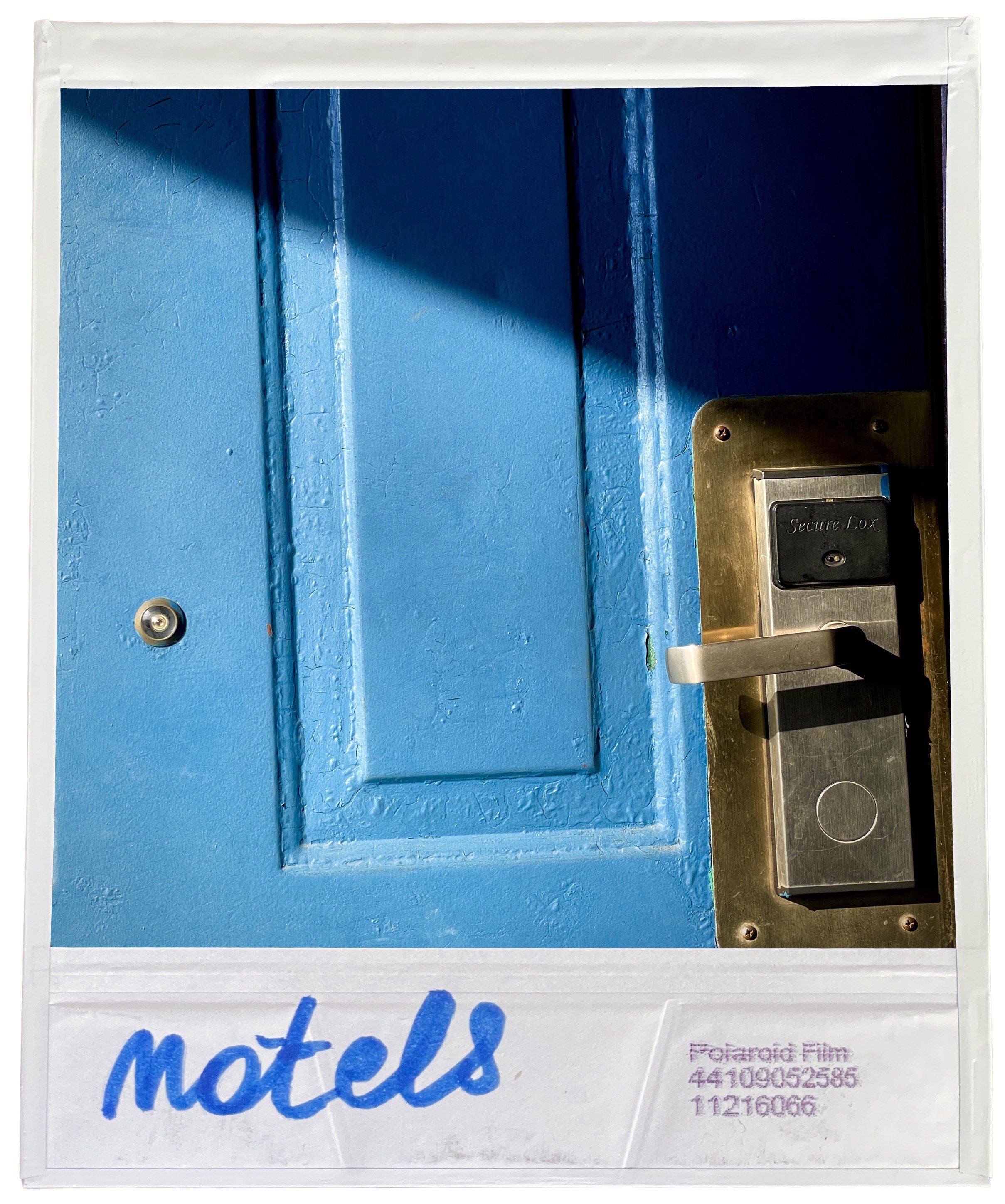
Sometimes it comes from the machine in the room, a contraption visibly designed to produce four tablespoons at a time with a weird gurgling noise. The packet is miniature. The cup is miniature. What comes out of it tends to be equally modest.
Nobody has ever looked less like civilization than a man standing barefoot on motel carpet at 5:47 in the morning waiting for four ounces of brown water to drip into polystyrene.
And yet, I make it. Of course I make it. Its function is chronology more than flavor. It means the day has started. Good enough.
While it drips, I look around at whatever has spread across the room since the evening before. Clothes, receipts, film, camera bag, keys. Everything seemed organized when I went to sleep and somehow ended up everywhere by morning.
I drink the coffee, pack the rest, check the room and leave.
Motel-breakfast coffee.
Different world.
The giant insulated dispenser, sometimes three of them: regular, decaf and hot water. The silver plastic lever. The little cardboard sleeve. The pile of lids that never seem to correspond perfectly to the cups.
There is almost always someone in front of me examining the whole arrangement as though defusing a bomb while I stand behind at 6:14 wanting only caffeine.
Nearby, someone is making a waffle. The air smells of industrial scrambled eggs, maple syrup and coffee. A television is on somewhere.
Very little conversation is needed.
“Morning.”
“Morning.”
Sometimes somebody is blocking the regular coffee while trying to understand which lever does what. I wait. They notice me.
“Sorry.”
“No rush.”
There absolutely is a rush.
The sun is coming up.
Eventually the coffee is mine. I fill the cup, find a lid that almost fits, press around the edge twice and get out.
The size of that cup would once have seemed ridiculous.
At first: Jesus Christ.
A week later: perfectly normal.
Eventually a small cup looks absurd. Almost irrelevant.
A twenty-ounce coffee becomes a coffee.
Some mornings start earlier still. Jet lag.
I land in the States. The clock changes immediately. My body takes a less administrative approach.
The first few mornings, I wake absurdly early, still on Brussels time, and look at a motel clock displaying an hour I normally associate with going to bed.
Coffee helps. Badly, but it does.
I start driving. Hunger arrives at odd hours. Sleep comes too early or too late. Later in the trip, another time-zone line may take away an hour I was quite fond of. The car clock changes. The phone confirms. My stomach files an objection. I use coffee to negotiate all of this. Up to a point.
If I want the early light, I leave in darkness. The motel door clicks shut behind me. There may be cold air outside or the dry warmth of a desert morning. The car flashes when I unlock it. Everything around me is still reduced to parking spaces, motel doors and whatever the sodium lights manage to reach.
Coffee in one hand. Car key in the other. Camera bag on the shoulder. No photograph yet. No people. No great American scene unfolding for my benefit. Just a motel parking lot somewhere before sunrise.
The finished photograph begins much earlier than the first click of the shutter. Literally. It may begin there, with bad coffee in the dark before I have even decided where the first frame will happen.
Then I leave.
Coffee, radio, empty road.
That combination has repeated so often that it is now one of the most familiar parts of these trips.
I’m driving through a town whose name I had never heard three months earlier while local radio tells me about a roofing company, livestock prices, the weather, college football, God, politics and a mattress sale.
The advertisements are often funnier than the programs.
A man with a voice designed to sell agricultural machinery explains why his dealership has been serving the county since 1978. A woman tells me where to buy a mattress this weekend and why I would be foolish to wait until Monday. Someone warns that a storm may come through after lunch. Then a school team has won something, somebody needs Jesus, and we are back to roofing.
I drink coffee and listen.
That is yet another way the country reaches me: through exposure rather than research.
Coffee belongs to the road. The car gets gasoline. I get coffee. Both gauges eventually need attention, although the car’s is more precise about it.
Drinking and driving. Not that I put anything alcoholic in my coffee but come to think of it, there’s a certain amount of stupidity in that operation too.
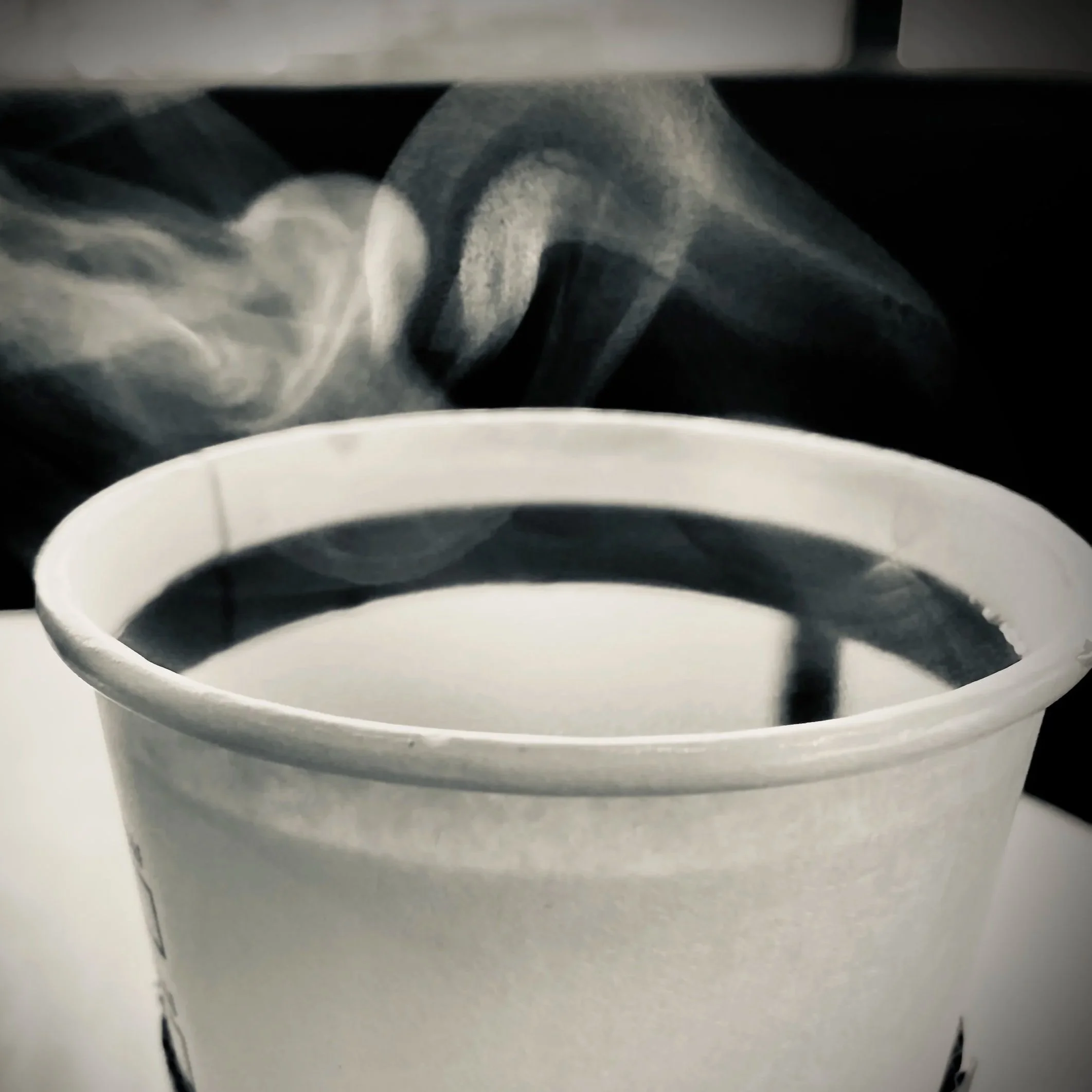
Assume the cup fits the holder (not always a certainty). The quick sideways glance to check where the lid is oriented before raising the cup from said holder. The first sip that is too hot as a rule. The possibility of catastrophe at every lift. Coffee is one of the few liquids people routinely attempt to drink at 70 mph without changing lanes or destroying Mississippi.
One hand on the wheel.
Eyes on the road.
Hot liquid held over my lap.
What could possibly go wrong? Other than half a liter of boiling coffee arriving in my crotch at highway speed. Type 3 fun.
First sip. Too damn hot. I know it, and yet…
Back into the holder. Ten minutes later, I try again. Perhaps still too hot. Then I see something. A side road. A building. Someone standing somewhere. A piece of light worth following. I pull over, take the cameras and get out for what looks like a quick stop.
Eventually I get back into the car and notice the cup.
Coffee. Right.
Cold.
I used to hate cold coffee. Recently, I have become less difficult about it. These days, a cold cup usually means I forgot about it while I was out of the car.
On an empty day, I can drink the whole thing while it is hot. On a good day, I may rediscover most of it an hour later.
I could probably create a photographic success scale from this.
Hot and finished: quiet morning.
Cold when I get back: things happened.
Still nearly full when I reach the motel: excellent day.
Measured in degrees Fahrenheit, obviously. There may be grant money available for this.
Empty cups stay with me for a while too. I keep a plastic bag behind the passenger seat for rubbish, and over a few days it fills with cups, bottles and whatever else the car has accumulated.
A coffee bought in one town may be thrown away in another. Sometimes it crosses a state line with me. I have occasionally entered a place partly to dispose of the previous cup and ended up walking back out carrying its successor. Very efficient.
There’s the coffee evidence too.
A drop on a receipt. A splash on motel paperwork. A ring on a notebook. A stain on a map. The passenger seat if things have gone badly (only once, I swear).
The brown ring is particularly good at documenting a trip. My notebooks leave home clean. They rarely come back that way.
Sometimes I stop because I need more than caffeine.
I need somewhere to sit.
Either I slept badly or the morning has produced nothing. Maybe the weather has closed in and wandering around with a camera would achieve little beyond getting wet. Sometimes I have been driving so long that another hour behind the wheel would make me stupid rather than productive.
So I find somewhere, sit down and order coffee.
This is one of the parts of travelling alone that rarely appears in the pictures. There are moments when I have no particular idea what to do next.
I have a general direction. I could keep driving. Another town, another road, whatever comes next.
Sometimes I’d rather stop. A couple of dollars buys me a table and half an hour in which no decision is required.
I drink coffee. I look outside. I look around. My phone mostly stays where it is. People come and go. Sometimes that is all that happens. Other times, someone notices the cameras.
“What are you doing out here?”
And we have begun.
America. Exposed, unposed.
Film. Square format. The road. The people. No, I am not from a newspaper. No, I am not making a commercial. Yes, they still make film. Yes, I really am travelling through all the states. No, I haven’t finished yet.
The last answer can lead almost anywhere.
Someone tells me where I should go next. Someone tells me where I should not go next. Someone insists that I have to see something twenty miles away. Someone asks whether I have been to their hometown. Someone wants to know which state I liked best, a question I dodge because I have learned how quickly a harmless answer can become a regional incident.
And somewhere in the middle of it, somebody tops up my coffee. I love that part of it. I cover the miles to get somewhere, then spend my time finding reasons not to leave. Coffee is there for both.
Back home, I naturally think of coffee in units. One coffee. Another coffee. Perhaps a third.
America introduced me to the bottomless cup principle.
The mug arrives. I drink some. Someone comes past and adds more. I drink again. More is poured before I finish what was already there. At some point, I have absolutely no idea how much coffee I have consumed because technically I seem to be drinking the same cup.
This triggered the part of my brain that likes useless questions.
If the mug is repeatedly topped up before becoming empty, when exactly has the original coffee disappeared? Have I drunk four coffees? Or one immortal one?
The mugs themselves help.
The classic diner version has a physical seriousness to it. Heavy, thick, white or off-white, built to survive falls, dishwashers, customers, decades. Possibly advertising the diner. Possibly completely anonymous.
There is something lovely about those mugs because they are almost the opposite of my cameras. Nothing precious. Nothing calibrated. Nothing requiring care. Drop it. Wash it. Fill it again. Next.
Somewhere in America, there must be a company whose entire business consists of producing white coffee mugs capable of surviving everything and everyone. I like them. They work. I’ve seen one fall to the floor and splatter coffee everywhere. Coffee everywhere. Mug intact.
I spend most of my time paying attention to differences between places I cross. There are days when discovery is wonderful. There are days when discovery is exhausting. Then a chain becomes relief. A little predictability at the coffee counter can be useful.
So, I occasionally walk through a door knowing exactly how the next three minutes will unfold. Same board. Same cup. Same procedure. I order, pay, leave.
Independent coffee shops are another matter.
Potentially good coffee. Potentially photogenic place. Potentially thirty minutes lost. The clientele can seem to belong to a completely different version of the town around it.
Laptop. Oat milk. Tattooed barista. Ceramic pour-over equipment. Local art. Wi-Fi password.
Then, three blocks away, the diner, feed store, gun shop and courthouse. Same town. Different coffee.
Sometimes I walk into one of these places, look at the board behind the counter and immediately regret having eyes. The menu occupies half a wall.
Names. Sizes. Origins. Methods. Things with foam. Things with no foam. Things whose temperature can apparently be specified within laboratory tolerances.
The person behind the counter looks at me.
“What can I get you?”
“Coffee.”
There is sometimes a pause.
“Drip?”
“Yes.”
“What size?”
“Medium.”
“Room for cream?”
“No.”
Done.
That is my ultimate level of complexity.
It helps that I drink it black. Period. No taxonomy. No Italian nouns. No choices about milk, foam, syrups, extra shots, temperatures or anything else capable of turning the purchase of caffeine into rocket science.
America, of course, has built an extraordinary number of possibilities around that simple word.
And then there is the creamer landscape.
Vanilla. Hazelnut. Caramel. French vanilla. Irish something. Pump dispensers, powders, plastic containers and perhaps entire substances unknown to European dairy science.
Mine stays black.
I still admire the machinery built around something nominally simple. Coffee is rarely just coffee, even when mine is.
The taste itself remains secondary most of the time, although some cups make themselves impossible to ignore.
There is ordinary coffee. Good coffee. Occasionally excellent coffee. Coffee that only bears the name of coffee; so weak I can still see the bottom of the mug.
And there is coffee from a pot that has been sitting on the hotplate since the Carter administration. You know it before the cup even reaches the table. Burned coffee is burned coffee.
I drink it anyway. Part of the charm.
At six in the morning, I am not looking for the perfect artisan coffee consumed at its optimal extraction temperature. I want something hot, black and available.
When it happens to be excellent, I appreciate it enormously. When it tastes like the Carter administration, I drink that too.
And since we are covering the alternatives, there is iced coffee.
This is where I draw a line. I know it exists for perfectly sensible reasons, particularly in desert heat, when buying something hot feels plainly ridiculous. I understand the theory. At some point hot coffee stops being psychologically plausible. Iced coffee is the obvious alternative. I have seen other people enjoying it.
I hate it.
I have watched people carry enormous transparent cups full of ice through temperatures in which a hot drink appears almost confrontational. Condensation runs down the sides. Ice rattles in the holder.
Coffee should start hot and become cold through neglect, the way nature intended. If it is already cold when I buy it, I see no reason to get involved. It’s disgusting.
Get a lemonade already.
In diners, I prefer the old system.
The question often arrives before my ass has properly touched the booth.
“Coffee?”
“Yes, please. Black.”
The mug lands. The pot tilts.
Later comes:
“More coffee?”
Sometimes there is no question at all. The waitress appears six feet away and raises the pot slightly.
That is enough. A small nod. I push the mug forward. Coffee arrives. The efficiency is almost military.
A raised pot is a question. A hand over the mug means no. Moving the mug toward the edge means yes. Eye contact can reduce the whole exchange to a movement of a few inches. That part was easy enough to grasp.
One expression took longer.
“Warm-up?”
The first time I heard it, I looked up.
“Sorry?”
She raised the pot a little.
“Warm-up?”
Half a second. Then I understood.
“Ah. Yes. Please.”
She refills the mug.
“Where are you from?”
There it was.
“Belgium.”
“Belgium?”
And off we went.
The coffee was suddenly almost irrelevant and the discussion started. Before long I was giving the short version of the project while she stood with the pot in one hand, occasionally looking towards another table to make sure nobody urgently required anything.
This happened a few times. The coffee is the excuse that gives both of us somewhere to stand.
People ask why I still shoot film. Sometimes they pick up on the square format. Some want to know whether I photograph everyone I meet. Others skip the camera entirely and want the route.
“How long you been on the road?” “Where you heading next?” “You been to Wyoming?” “You gotta go to…”
I have received enough unsolicited route advice to redraw the United States several times. Most of it is given with complete conviction. Somebody knows a town I cannot miss. A place where “you’ll get pictures.” A diner better than this diner (owned by a cousin or someone they went to school with).
Sometimes I write the name down. Sometimes I actually go. That is part of why I like sitting there. Coffee turns waiting into an activity.
For that reason, I’ve never bought coffee at a drive-through, despite how very American the whole setup is.
Order through a wall. A voice answers. There is a board involving far too many possible combinations. Pull forward. Coffee appears through a window. Nobody leaves the car. The whole transaction is designed so I never have to stop.
I dislike the grab-and-run conception of photography. I travel slowly precisely to absorb a place, and part of that means spending time doing very little.
Being there, on my own, a mug in front of me, gives that time a shape. I can sit, watch the room, look through the window and leave the next half hour open. Drinking coffee is one of the remaining socially acceptable ways to do nothing in public. Coffee is camouflage for patience.
In Texas, I was sitting with one when a humongous hay truck passed outside.
Not a truck carrying hay in the European sense of the expression. This thing seemed to consist mostly of hay, with a cab attached somewhere at the front as a technical requirement.
My attention left the table immediately.
That is the problem with sitting down as a photographer. The sitting can end without warning. Unfortunately, I couldn’t just leave like that this time, but I managed to leave fast enough to catch the truck.
Whether the picture works or not comes later. The interruption itself is the point. One minute I’m having coffee. The next I’m chasing a hay truck.
And sometimes the opposite happens. Nothing appears. Nobody interesting walks past. The light remains awful. The afternoon stays flat. I drink the coffee to the bottom. Pay. Leave. That is part of the work too.
On occasions, ordering isn’t necessary.
“You want a coffee?”
I know what usually follows.
I stay.
I was running after a crop-duster in Arkansas. Chased it down to the landing strip and ran to the office to ask permission to photograph it. By the time I caught up with the plane, it was already about to take off again. The shooting lasted about 47 seconds.
Back to the office.
“Thanks so much; how long before he’s back?”
“One and a half hours at least.”
“Mmh, too long for me.”
“You want a coffee?”
An offered coffee gives the conversation more time. We sit down, or remain where we are, and the questions begin again.
The repetition does not bother me at all because the conversations never follow exactly the same route. By state twenty-something, I will perhaps be able to explain America. Exposed, unposed. before the coffee cools.
People are often curious about what an outsider notices.
Sometimes they want confirmation of something they already believe about their state. Sometimes they want to know what surprised me. Occasionally they begin answering their own question before I can.
“You probably think we’re all crazy here.”
Or:
“Bet you don’t have anything like this in Belgium.”
Sometimes correct.
Sometimes spectacularly incorrect.
I have learned that correcting the finer points of Belgian life is rarely necessary before the second refill.
I could probably write a book about the questions I get asked along the way. Maybe I will.
Time of day creates another calculation. 3:40PM, still miles to cover and I know another cup will help. All fine. Then, there is the 5:30PM decision, which is more dangerous. I know what will happen later. I know I will arrive at the motel tired enough to sleep and caffeinated enough not to. I buy the coffee anyway. Some lessons require repetition.
Which reminds me of that one night. I just couldn’t sleep. No particular reason, no coffee involved —yet, just one of those nights. Simply fully awake and somewhat bored.
So, I decided to do what I do. Drive.
Eventually, I had to refuel. The car and me. I find a truck stop by the highway.
Pumps outside. Pumps inside.
Unleaded. Diesel. Regular. Dark roast.
America offers several grades of fuel.
Familiar faces, guys in for the long haul. A few heads lift from the umpteenth coffee or the steamy hot plate of something.
I sit down and right away, I realize how much I ache. More than I wanted to admit earlier in the motel. Feels good to be here, sitting, pausing. I’m probably looking slightly too interested in everything. The waitress asks where I’m from. “Belgium. Last time I checked.”
It sounded funnier in my head.
Coffee will do.
By now, many of the things that caught my attention during the first trips barely register.
The cup sizes. The refills. The pot coming towards a mug that is still half full. The “Warm-up?” question. I learned all of it simply by being there.
I came to photograph a country I did not grow up in. I could read endlessly before each trip, research every place, arrive knowing the history and the statistics and what someone else thinks I should notice.
Some basic preparation is useful. But then I have to go there. Sit down. Order coffee. Listen. Get things wrong. Understand the expression half a second late. Learn that the small cup is pointless. Learn when to cover the mug with my hand. Learn how much coffee I can drink at 5:30PM without destroying the night. Learn that “Where you from?” is often the beginning of another hour I had not planned.
That is closer to the culture I came to meet. Not studied at arm’s length. A succession of moments that eventually stop feeling foreign. The cardboard sleeve sliding out of place, the puddle under a diner mug, a paper cup slowly softening, the first drop hiding under the lid, asking for one to go.
And there is one gesture at the other end of all this that I know particularly well.
The cup is empty. I look down at it.
“Well…”
Last sip if there is one left. Cup back on the table.
Hands on my knees.
Time to go.
Then, occasionally, from somewhere over my shoulder: “Warm-up?”
I look at the pot.
“Yeah. Why not.”
And I sit back down.